Saturday, 4 April 2020

Finding my first French family line!

If you follow my genealogy Instagram account, you might know that last fall I finally broke down one of my more persistent brick walls and found my first French family line! To make a long story short, newly digitized Belgian records revealed a marriage record for my 4x great grandparents Jacques (Jacobus) Verfaille and Sophie Hutinet which included information about Sophie's parentage which led me to her father's death record which was also part of this treasure trove of Belgian records that has recently become available online.

Simon Hutinet's death record in the Tournai municipal record books, 10 April 1801.

Simon Hutinet's death record noted his birth place as being Dampierre "ci-devant diocese de Langres (above the Diocese of Langres)" and that he was the son of Claude Hutinet and Anne Testevuide. This was incredibly useful information which was able to lead my research trail into France! After joining a few French genealogy groups on Facebook and taking a crash course in what kind of records are available, I was pleasantly surprised by how detailed the French records are and how much is digitized online for free! It wasn't long before I had found the parish records for the little village of Dampierre, and using Simon's parents names and his age at death, was able to locate a baptismal record for him.

Simon Hutinet's baptism record, Parish of Dampierre record books, 29 September 1755.
Being new to researching in both French records and Catholic records, it took me hours to come up with a transcription of this baptismal record as follows:
Le vingt neuf Septembre mil sept cent cinquante cinq a été baptise Simon né dujour preceedent, fils en ligitime mariage de Claude Hutinet meunier en Previard et d'Anne Testevuide ses pere et mere et aux pour parrain Simon Dapremont pretre frere de Dampierre represente par Dominique Testevuide son oncle maternel et pour marraine Denise Testevuide aussi sa tante maternelle fille de Nicolas Testevuide fermier de notre dame duchênes qui a declare ne savoir signee. le parrain font soussigné avec nous le pere absent.
In a rough English translation this reads: "The 29 September 1755 was baptized Simon, born the day before, son of the legitimate marriage of Claude Hutinet, miller at Previard and of Anne Testevuide, his father and mother. And for godfather Simon Dapremont Priest of Dampierre represented by Dominique Testevuide his maternal uncle, and for godmother Denise Testevuide also his maternal aunt, daughter of Nicolas Testevuide, farmer at Notre Dame du Chenes, who said she does not know how to sign. The godfather are the undersigned with the father absent." The diocesan history for Langres indicates that Simon Dapremont, born in 1725, was the parish priest in Dampierre from 1753 to 1793. The Hutinet family must have had an affinity for their young priest to both name their son Simon (presumably in his honour) and to ask him to act as young Simon's godfather.

Église Saint-Pierre et Saint-Paul, photo from the Langres Tourism website.


At left is an old postcard showing Dampierre's village centre and church, Église Saint-Pierre et Saint-Paul, where Simon was baptized. My research has indicated that only the nave (centre portion of the building between the steeple and chancel) would date back to the 1700s, as there were extensive renovations in 1844 which restored the steeple and enlarged the chancel area.


For someone used to researching 18th century ancestors in Canada for whom almost no records remain or 18th century ancestors in the UK for whom parish records record the bare minimum, this level of detail was so exciting! Not only does the baptismal record make note of Simon's parents' full details including his mother's maiden name, father's profession, and family residence; the record also lists the relationship between the godparents and Simon which allowed me to piece together his maternal side, the Testevuide family. Evidently Anne had both a brother and sister and was also the daughter of Nicolas who was a farmer living at the Notre Dame du Chênes farm.

With this information, the helpful Facebook genealogy community pointed me in the direction of a series of maps that Napoleon had commissioned in 1807 to create a nation-wide geographical survey with the aim of using this information to establish taxation rates. Haute-Marne, the geographic department wherein Dampierre lies, has put their maps online, so I was quickly able to find a map of what Dampierre looked like in the early 1800s and find the locations of Pré Viard (in green box) and Notre Dame du Chênes (in blue box).
Map of Dampierre with village in the centre labelled F,  Pré Viard Farm to the south west labelled and enlarged in green,
and Du Chêne Farm to the north of the village labelled and enlarged in blue.

Old post-card showing a view of Dampierre. 

The Haute-Marne area is in a rural part of France "with 40% of the [region being] either river or forest" and a low population density ranking in the bottom 10% for the whole country. The village of Dampierre was primarily centred around an agrarian economy with many small family farms. A description of a typical home in the area at the time includes a simple dwelling structure with a door, two windows and a tiled roof, a stable and barn, and an outdoor bread oven. According to "La diocèse de Langres: histoire et statistique", in 1750 Dampierre had about 420 inhabitants and was still rebuilding after suffering damage during military conflicts, an earthquake, and a plague outbreak all of which occurred in the 1600s.


Next, I wanted to find out more about what it meant for Claude Hutinet to be a miller at Previard. A Google search brought up a local dictionary/directory book published in 1858, "La Haute-Marne ancienne et moderne: dictionnaire géographique, statistique, historique et biographique de ce département". In describing the village of Dampierre, they list one of the main features being "plusieurs moulins dont l'un est appelé Pré-Viard (many mills including one called Pré-Viard)." An English-language tourism brochure for the area gives a little more information about what this mill would have been like, stating: "At the south west of the village, at the foot of the road leading to Charmoilles, at the place name 'Pré Viard', existed a water-mill until the last XIX century." These two sources indicate that the Pré Viard mill was something of a landmark in Dampierre (perhaps the most substantial mill in the village?), a waterwheel not a windmill, and that the structure is no longer standing. Simon's baptismal record gives another hint about the Pré Viard mill... his father Claude was not present at his baptism in September, a fact that is somewhat unusual but perhaps makes more sense if the assumption is made that the mill was used for cereal/grain crops in which case September was probably when Claude was at his busiest grinding the village's fall harvest.
Engraving of a waterwheel published in "L'encyclopedie, ou Dictionnarie Raisonne des Sciences, des Arts et des Metiers" (Diderot, Paris, 1751).

Cross-section of waterwheel published in "L'encyclopedie, ou Dictionnarie
Raisonne des Sciences, des Arts et des Metiers" (Diderot, Paris, 1751).

An online French travel magazine, when describing a similar watermill that is still in existence in another village in Haute Marne just thirty kilometres from Dampierre, states: "People have been working the water here since the Romans and this was once one of the pivotal businesses of the community. During the revolution, the mill was considered so important that the miller was charged an extra pig by way of taxation. . . . The mill has a rhythm and a musicality to it. It must have been hot, dusty and noisy back in the day. It must have been a wonder in technology but still back breaking work. And today, you can enjoy . . . a little glimpse of what made the heart of this community tick!" Further research into the effects of the French Revolution on millers indicates that many mills were seized and turned into cooperatives during this time, perhaps a hint towards why Simon did not follow in his father's footsteps to become the local miller and instead ended up in living in Belgium after the revolution (I am still hoping to uncover exactly when and why he made the move).

Both of these watermill engravings come from "L'encyclopedie, ou Dictionnarie Raisonne des Sciences, des Arts et des Metiers" edited by the famous enlightenment writer Denis Diderot and published in 1751. What makes this particularly interesting for me from a genealogical standpoint is that Diderot was born and raised in Langres, the main metropolitan centre just fifteen kilometres from Dampierre, situating these illustrations in both the right time and place to be relevant for understanding the Pré Viard mill and what it may have looked like.


Turning my attention to the Testevuide family, I started looking into the significance of the farm name "Notre Dame du Chênes (Our Lady of the Oaks)".  Research showed that "such customs as that of fixing plaques or statues of our Lady on oak-trees, or of giving these shrines titles of 'Our Lady of the Oak', were both widespread and ancient." (H.M. Gillett, "Our Lady of the Oak Tree", Life of the Spirit, 1948)
Shrine to Notre Dame du Chêne, photo from Langres Tourism website.

The Langres Tourism website gives an excellent description of the history and significance of the site
: "On the territory of the old ruined Du Chêne Farm, there remains the chapel and the source of the farm's name. Tradition says that a statue of the Virgin was found in [the trunk of] an oak tree [by a bull grazing in the field]. Following this miracle, hermits settled in this place and the first chapel was built in the 12th century. Hermits lived there until the 17th century, when the chapel was bequeathed to the Discalced Carmelites. Later neglected, the chapel ended up in very bad condition and was demolished by 1788. The statue of Our Lady of the Oak was however saved. It is said that after being brought into the village and placed in the Church of Dampierre, she returned to the chapel by herself on several occasions. In 1844, the chapel was replaced by a small oratory. In its gable wall, a stone from the old chapel was encrusted. It carries this dedication: 'Here the love of Our Lady of the Oak is in your big heart, passer-by don't forget it'. The rebuilt chapel is the site of a pilgrimage every year in September."

While the image at right shows the 19th century oratory, rather than the chapel that would have been located on the farm when the Testevuide family lived there and worked the land, it gives an idea of the sort of sacred space that would have been part of their daily life. I like to imagine Simon's mother Anne growing up on this farm and perhaps taking a few minutes when her chores were finished to go pray in this little woodland chapel.


There is so much more information out there on this little village and the Hutinet and Testevuide families! The parish record books have been digitized back into the 1600s at least, and I have found a website that has a wealth of legal documents digitized from the 1700s including property sales, petty complaints about stray cattle, and minor children guardianships which will provide greater insight into my Hutinet and Testevuide ancestors' stories. I am looking forward to diving into more French records over the years ahead, but first I need to brush up on 18thC French script and Church Latin to be able to decipher them!

Saturday, 23 November 2019

Newcastle Narratives: James Charles Breem and the stolen pigeons


After spending far too much time recently searching through the British Newspaper Archives, today I am launching a new series on the blog called "Newcastle Narratives" which will feature stories I have uncovered about my family members that were living in Newcastle during the Victorian era and their many escapades that often seem to be straight out of a Dickens novel. Up first is a story about James Charles Breem (1846-1883), the brother to my 3x great grandmother Jane Ann, who had his pigeons stolen from the family's backyard. While this story is periphery to my direct line of ancestors, it has provided me with fascinating insight into the Breem family and the household in which Jane Ann grew up.


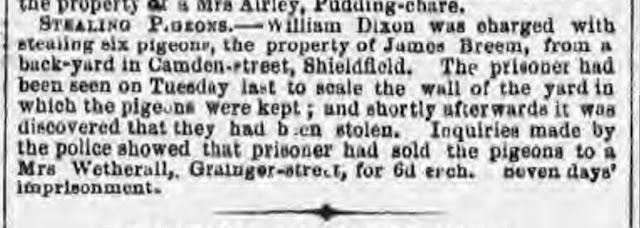
The first newspaper clipping I found that mentions the events was published in the Newcastle Courant's "Police Intelligence" column on March 29, 1861 and describes how the thief climbed over the wall into the family's yard and sold the pigeons for a sixpence (about £2.29 in today's currency) each to a shopkeeper on Grainger Street. He was convicted and sentenced to seven days in prision.


While this photo is taken 100 years later in Aldwark, York, the structure on the left of the image gives a good idea of what a pigeon loft would look like in the backyard of a working class family home. It is likely that James would have built something similar to house his pigeons and that the pigeon cote would have taken up most of the space in their cramped city backyard. In the north of England, "the wooden pigeon lofts, often made from waste timber and painted brightly to attract the birds, formed a distinctive feature of the landscape." (Johnes, 361)


The second story I found while searching the newspaper archives was published in the The Newcastle Guardian on March 30, 1861. The column titled "Newcastle Police Court" provided additional information about the case including that it heard on a Thursday before the same magistrate as the day before, Ald. Dodds and Sillick. This account of the event differs in a few key facts: the family's house is listed as being on Franklin Street rather than Camden Street, Mrs. Wetherall morphs into Mr. Weatherill, and in this clipping James is credited with finding the birds rather than the police investigation tracking down the suspect.


While largely impossible to determine which article is more truthful, census records can provide a few clues. The same year that the bird snatching occurred, a UK census was held. James, then 15 years old is listed as living with his step-mother Ann, brother Robert, and sister Jane Ann (my 3x great grandmother). Their father, John Charles, is not recorded with the family as he is enumerated in harbour in London on board the ship Hudgill, which he captained for many years traveling coasting routes transporting coal shipments from the mines near Newcastle.  James is working as a coal miner's clerk, a first step towards his future career as an accountant. The family's address is listed as 14 Camden Street leading me to believe that the address given by the first newspaper article in the Newcastle Courant is more factually accurate than the Franklin Street address provided in the second clipping from The Newcastle Guardian.


This map of Newcastle from 1864, just three years after the pigeon incident, shows the location of both Camden Street and Franklin Street within a few blocks of each other in the Shieldfield neighbourhood of Newcastle. The full map is available at Newcastle Collection to situate the location of Shieldfield within Newcastle more broadly.


A description of the neighbourhood in 1807 published by D. Akenhead and Sons in "The Picture of Newcastle Upon Tyne Containing a Guide to the Town & Neighbourhood, an Account of the Roman Wall, and a Description of the Coal Mines" reports on Shieldfield as follows: "At the further end a steep hill with houses on one side, called Pandon Bank, ascending which, and keeping to the left, you reach Pleasant Row and Shield Field, two ranges of very good houses in an airy and elevated situation, a little out of town."

In 1827, another report of Newcastle described how houses in Shieldfield had gardens behind, as evidenced in the reports of the pigeons being kept in the Breem's yard. The report writes: "Fronting the east, there is a row of good houses, very properly styled Pleasant Row, beyond which is another, named Shield Field, from the ground on which it stands. These houses command an agreeable prospect, have a range of beautiful gardens behind, and are, in every respect, very convenient as a retreat for men of business."

Kent Street via the Newcastle Libraries Flicker page.


However, by the time James Breem had his pigeons stolen from the backyard in 1861, Shieldfield was experiencing rapid population expansion. A comparison of maps from the time period show how the city was growing quickly out into former suburbs bringing with it larger numbers of working class residents and more cramped living conditions. This picture from Newcastle Libraries depicting Kent Street, one of the five streets within the same area as Camden Street and Franklin Street, shows what the front of the typical row houses looked in the period.


After reading these newspaper clippings, I was immediately curious why James would have been keeping pigeons in his backyard. The fact that one of the articles indicate that he was able to recognize his birds in another shop leads me to believe that he had an attachment to them that went beyond just raising them as meat birds (although I have watched enough of Mrs. Crocombe's cooking videos on English Heritage's YouTube channel to know that pigeon pie is not just a nursery rhyme creation!). Furthermore, the fact that they were not immediately butchered upon being stolen or sold, makes me believe that they were bought by the Weatheralls for another purpose. A quick Google search brought up an article titled "Pigeon Racing and Working-Class Culture in Britain, c. 1870-1950" by Martin Johnes which was published in Social History, Volume 4, Issue 3.

A cabinet card photographed by C. A. Solomons of Watford showing two Victorian-era men with their racing pigeons.
While reading the article I was fascinated to learn that pigeon keeping and pigeon racing was extremely popular throughout the Victorian era and into the 20th century particularly in working class mining communities in the north of England such as Newcastle. The article details how "in the 1760s pigeon fancying – keeping birds for their aesthetic and intellectual appeal – became quite common amongst the leisured class. . . . [and] in the 1840s and 1850s the rapid growth of the telegraph led to a decline in the use of pigeons for messages and some birds owned by merchant and press agencies came onto the open market, leading to the growth of pigeon racing amongst individuals" (Johnes, pages 362-363) including those of lower classes who could not previously afford to participate in pigeon keeping. Local communities would hold pigeon races on Sundays and "birds were trained to fly back to their lofts at a low height, sometimes never higher than six feet, in order to maximize their speed over races that could be as short as a mile. Each pigeon was marked by ink for identification and, after reaching its loft, its owner had to take it to the race headquarters, usually an inn, with the first bird there being declared the winner. Inequalities in the location of lofts could be equalized by forcing owners to draw lots for where their birds were released from." (Johnes, 363) The article goes on to describe how pigeon racing was linked to tensions in respectability and capitalism in the time period.

While I can't prove that James Charles Breem kept his pigeons for this purpose, it is certainly a plausible hypothesis given the story told in the newspaper clippings.  Six years later in August 1867, James married Ann Hunter, the only daughter of a veterinary surgeon. Perhaps his love of pigeons led to them crossing paths... it is pure speculation, but I can imagine that the local vet could have run in the same circles as a young pigeon fancier.

Pigeon racing in Victorian England circa 1870.

Sunday, 13 May 2018

Happy Mother's Day!

Thankful for all the amazing mothers that are part of my family story!
My maternal grandmother, my mother, and me circa 1995.


Saturday, 12 May 2018

When You and I Were Young, Maggie - Genealogical Tunes

"But to me, you're as fair as you were, Maggie, when you and I were young..."

Innes Rae Melvin at age 19 shortly before
immigrating from Scotland to Canada.

In 1888, Innes Rae Melvin (1866 - 1920) started work as a ferryman taking incoming settlers and grain shipments across the Souris River in south-western Manitoba. He charged 25 cents to take a wagon with team across the river and lived in a tent by the river during the summer months in order to be available on demand for river crossings. 

That same year, Widow McRae was immigrating to Manitoba from Ontario along with her many children, including her daughter Margaret Florence McRae (1873-1920), to join her oldest son John who had already been farming in the area for two years. Following the death of her husband, Farquhar McRae, the young widow knew that her thirteen children would have better opportunities and access to farm land if they pioneered west.

The McRaes were able to travel as far as Deloraine, Manitoba by railway; however, they had to bundle all their farm equipment, food supplies and personal belongings into wagons to cover the last 50 kilometres to their homestead.  With the Souris River lying between them and their destination, they had to make use of Innes Melvin's small ferry to cross over the river safely.

Their daughter Bella wrote down what happened next:


Margaret Florence McRae at age 17 while she 
was working in Reston MB as a school teacher.


"Maggie, who had taken her Third Class (Grade X) examinations in Ontario, stopped in Winnipeg to attend Model School (teacher training). . . .

Later, the men around town were joking the young ferryman (father) about the family of girls he had taken across the river.  They asked him if he had picked a wife from among them.  To which he replied, 'No, I'm waiting for the one who stopped in Winnipeg.'

In 1891 Maggie McRae, after teaching for a year in a school near Reston, was engaged as a teacher in the South Antler School, about nine miles south of Melita.  Before long, Innes Melvin, who had homesteaded on 22-4-28, was courting her.  Old-timers recall the young couple walking through the bush at Sourisford, swishing the mosquitoes away with branches.

On December 24, 1891, the words spoken in jest by Innes Melvin in the fall of 1888 cam true when he and the young school teacher were married in Melita." 
- (The Melvin-McRae Story by Isabel Reekie, Chapter 2)


From all accounts, the Melvin home was both happy and always full of music.  Neighbours remember knowing that Innes was coming over for a visit because they could hear him singing on horseback before he arrived.  Their children remember Maggie always singing to them at bedtime and while she worked at household chores, cooking big meals for a threshing crew or knitting new winter mittens.  One song in particular stood out as a favourite, When You and I Were Young, Maggie.

"Mama's name was Margaret (she got Maggie). Mama had a clear, sweet soprano voice.  Often she and Papa sang When You and I were Young, Maggie - he coming in with his bass, though he usually sang baritone.  It was their song." 
- (The Open Door by Isabel Reekie, pg 8)

Innes and Maggie in the 1910s.

Of course as soon as I read that quote calling it their song, I had to track down a recording of When You and I Were Young, Maggie to have a listen.  Luckily it seems to have been a rather popular track (in fact it was added to the Canadian Songwriters Hall of Fame in 2005), so I had easy access on YouTube to a number of different recording versions online.  I've embedded my favourite version at the top of this post, and it still makes me a little emotional to listen to...

I am forever grateful to their daughter Bella Melvin Reekie for recording her childhood memories and family stories into two books which she shared amongst family members.  Those kind of details  are impossible to know from records alone and would be lost in time without someone taking the time to preserve them in writing.  It is such an incredible gift to know my 2x great-grandparents' favourite song and to be able to still sit and listen to the same music they used to sing as a duet almost 130 years after they first started courting and fell in love while walking through the prairie grasses on the plains of Manitoba!

Friday, 11 November 2016

Remembrance Day...


Thankful for the generations before me who were willing to make sacrifices to defend the rights, freedoms, and peace I now enjoy. Lest we forget... 


Row 1: William Middleton (2x great-grandfather), Pieter Ruiter Sr (great grandfather), William McDermit (2x great-uncle, KIA WWI), Innes Melvin (2x great-uncle, KIA WWI)

Row 2: Edward McDermit (2x great-uncle, KIA WWI), Pieter Ruiter Jr (grandfather), John McDermit (great-uncle)


Tuesday, 14 June 2016

Making the Most of a Family Reunion...


The dirt hills of Saskatchewan. 1980s | 2010s

"Last summer, thanks to some last minute flight deals, I was fortunate to be able to attend my first official family reunion! Although my mom’s immediate family gathers together frequently, this was a reunion for everyone descended from my 2x great-grandparents, so there were lots of family members attending who I had never even met before. Plus, it was held at my great-grandparents’ homestead in Saskatchewan, Canada.

Here are a few (hopefully helpful!) tips for attending a reunion to help you prepare to visit with family this summer and learn from my mistakes and successes..."

Click here to finish reading the rest of my guest post for the Next Gen Genealogy Network May newsletter!

Sunday, 5 June 2016

The 99+ Genealogy Things Meme

This is an old meme (started by Rebecca Wiseman who blogs at "kinexxions"), but I'm a new blogger and it seemed like fun, so here it is anyway!

"The list should be annotated in the following manner:
Things you have already done or found: bold face type
Things you would like to do or find: italicize
Things you haven’t done or found and don’t care to: plain type"


  1. Belong to a genealogical society.
  2. Researched records onsite at a court house.
  3. Transcribed records.
  4. Uploaded tombstone pictures to Find-A-Grave.
  5. Documented ancestors for four generations (self, parents, grandparents, great-grandparents).
  6. Joined Facebook.
  7. Helped to clean up a run-down cemetery.
  8. Joined the Genea-Bloggers Group on Facebook.
  9. Attended a genealogy conference.
  10. Lectured at a genealogy conference.
  11. Spoke on a genealogy topic at a local genealogy society.
  12. Been the editor of a genealogy society newsletter.
  13. Contributed to a genealogy society publication.
  14. Served on the board or as an officer of a genealogy society.
  15. Got lost on the way to a cemetery.
  16. Talked to dead ancestors.
  17. Researched outside the state in which I live.
  18. Knocked on the door of an ancestral home and visited with the current occupants.
  19. Cold called a distant relative.
  20. Posted messages on a surname message board.
  21. Uploaded a gedcom file to the internet.
  22. Googled my name.
  23. Performed a random act of genealogical kindness.
  24. Researched a non-related family, just for the fun of it.
  25. Have been paid to do genealogical research.
  26. Earn a living (majority of income) from genealogical research.
  27. Wrote a letter (or email) to a previously unknown relative.
  28. Contributed to one of the genealogy carnivals.
  29. Responded to messages on a message board or forum.
  30. Was injured while on a genealogy excursion.
  31. Participated in a genealogy meme.
  32. Created family history gift items.
  33. Performed a record lookup for someone else.
  34. Went on a genealogy seminar cruise.
  35. Am convinced that a relative must have arrived here from outer space.
  36. Found a disturbing family secret.
  37. Told others about a disturbing family secret.
  38. Combined genealogy with crafts.
  39. Think genealogy is a passion not a hobby.
  40. Assisted finding next of kin for a deceased person.
  41. Taught someone else how to find their roots.
  42. Lost valuable genealogy data due to a computer crash or hard drive failure.
  43. Been overwhelmed by available genealogy technology.
  44. Know a cousin of the 4th degree or higher.
  45. Disproved a family myth through research.
  46. Got a family member to let you copy photos.
  47. Used a digital camera to “copy” photos or records.
  48. Translated a record from a foreign language.
  49. Found an immigrant ancestor’s passenger arrival record.
  50. Looked at census records on microfilm, not on the computer.
  51. Used microfiche.
  52. Visited the Family History Library in Salt Lake City.
  53. Visited more than one LDS Family History Center.
  54. Visited a church or place of worship of one of your ancestors.
  55. Taught a class in genealogy.
  56. Traced ancestors back to the 18th Century.
  57. Traced ancestors back to the 17th Century.
  58. Traced ancestors back to the 16th Century.
  59. Can name all of your great-great-grandparents.
  60. Found an ancestor’s Social Security application.
  61. Know how to determine a soundex code without the help of a computer.
  62. Used Steve Morse’s One-Step searches.
  63. Own a copy of Evidence Explained by Elizabeth Shown Mills.
  64. Helped someone find an ancestor using records you had never used for your own research.
  65. Visited the main National Archives building in Washington, DC Library and Archives Canada in Ottawa, Ontario.
  66. Visited the Library of Congress.
  67. Have an ancestor who came over on the Mayflower.
  68. Have an ancestor who fought in the Civil War.
  69. Taken a photograph of an ancestor’s tombstone.
  70. Became a member of the Association of Graveyard Rabbits.
  71. Can read a church record in Latin.
  72. Have an ancestor who changed their name.
  73. Joined a Rootsweb mailing list.
  74. Created a family website.
  75. Have more than one "genealogy" blog.
  76. Was overwhelmed by the amount of family information received from someone.
  77. Have broken through at least one brick wall.
  78. Visited the DAR Library in Washington D.C.
  79. Borrowed a microfilm from the Family History Library through a local Family History Center.
  80. Have done indexing for Family Search Indexing or another genealogy project.
  81. Visited the Allen County Public Library Genealogy Center in Fort Wayne, Indiana.
  82. Had an amazing serendipitous find of the "Psychic Roots" variety.
  83. Have an ancestor who was a Patriot in the American Revolutionary War.
  84. Have an ancestor who was a Loyalist in the American Revolutionary War.
  85. Have both Patriot & Loyalist ancestors.
  86. Have used Border Crossing records to locate an ancestor.
  87. Use maps in my genealogy research.
  88. Have a convict ancestor who was transported from the UK.
  89. Found a bigamist amongst the ancestors.
  90. Visited the National Archives in Kew.
  91. Visited St. Catherine's House in London to find family records.
  92. Found a cousin in Australia (or other foreign country).
  93. Consistently cite my sources.
  94. Visited a foreign country (i.e. one I don't live in) in search of ancestors.
  95. Can locate any document in my research files within a few minutes.
  96. Have an ancestor who was married four times (or more).
  97. Made a rubbing of an ancestors gravestone.
  98. Organized a family reunion.
  99. Published a family history book (on one of my families).
  100. Learned of the death of a fairly close relative through research.
  101. Have done the genealogy happy dance.
  102. Sustained an injury doing the genealogy happy dance.
  103. Offended a family member with my research.
  104. Reunited someone with precious family photos or artifacts.